
Have you ever set a New Year's resolution to "read more books," only to find yourself abandoning it by March? You're not alone. According to Pew Research Center, while 78% of adults believe reading is crucial for personal growth, only 23% maintain a consistent reading habit. The problem isn't lack of willpower or desire. It's the approach. Traditional "just push through it" methods often lead to frustration and abandonment. But here's the good news: neuroscience and behavioral psychology have uncovered a proven system for habit formation that works for anyone, regardless of how busy you are or how many times you've failed before. This article reveals a science-backed, 5-step method that can help you transform from "wanting to read" to "reading every day" in just 30 days. Whether you're a busy professional, a student, or a lifelong learner looking to level up, this system will make reading as automatic as brushing your teeth.
The Science Behind Habit Formation: How Your Brain Creates New Habits
Before diving into the specific steps, understanding the neuroscience of habit formation is crucial. This knowledge not only helps you execute the strategies more effectively but also maintains your confidence when challenges arise.
The Habit Loop Theory
Charles Duhigg, author of "The Power of Habit," identified three core elements in what he calls the "habit loop": the cue (a trigger that initiates the behavior), the routine (the habit itself), and the reward (the positive feeling that reinforces the behavior). Research from MIT shows that when this loop repeats enough times, your brain converts it into an automatic program stored in the basal ganglia. This is why old habits are so hard to break and why new habits, once formed, become effortless.
The Real Timeline: 21 Days vs 66 Days
Popular wisdom suggests it takes 21 days to form a habit, but research from University College London tells a different story. Dr. Phillippa Lally's study found that the actual average is 66 days, with a range from 18 to 254 days depending on the complexity of the behavior, initial motivation level, environmental support, and past similar experiences. This means 30 days is just the beginning phase of habit formation, but it's enough to experience significant change and establish initial automaticity. The key is understanding that you're building momentum, not reaching a finish line.
The 1% Improvement Rule: Atomic Habits
James Clear's "Atomic Habits" introduces a powerful concept: improving by just 1% each day leads to being 37 times better after one year through compound effects. The mathematical principle is simple but profound. If you get 1% better each day for a year, you'll end up 37.78 times better by the end (1.01^365 = 37.78). The critical insight for reading habits is to start with tiny, sustainable behaviors rather than pursuing dramatic overnight changes. Reading for 3 minutes daily is far more effective than attempting an hour from day one. The former builds a foundation; the latter often leads to burnout.
Step 1: Start with Micro-Habits — Just 3 Minutes a Day
Why Micro-Habits Are Powerful
Dr. BJ Fogg, director of Stanford University's Behavior Design Lab, discovered through extensive research that the biggest obstacle to habit formation isn't lack of motivation but behavior threshold that's too high. When you set a goal like "read 30 minutes daily," exhausted evenings become excuses for failure. His research shows that making behaviors tiny dramatically increases success rates. Micro-habits offer three distinct advantages. First, they eliminate psychological resistance—3 minutes doesn't feel daunting or burdensome. Second, they guarantee execution rate—even your busiest days can accommodate 3 minutes. Third, they create a success loop—each completion reinforces your "I can do this" belief, which is crucial for long-term adherence.
The 3-Minute Reading Method: Practical Implementation
To implement this effectively, choose a fixed time that occurs naturally every day, such as morning coffee, after lunch, or before bed. Select a designated reading space like a desk corner, bedside table, or specific spot on your couch. Lower the barrier by keeping your book or device within arm's reach, opened to the specific page. Set a timer using your phone or a tool like 3MinTop's built-in timer to ensure you only need 3 minutes. The scientific basis for this approach is compelling. Duke University research reveals that 45% of daily behaviors are habitual rather than conscious decisions. By linking reading to an existing daily moment like drinking coffee, you leverage what psychologists call "implementation intention," which triples success rates compared to vague goals.
How 3MinTop Supports Micro-Habits
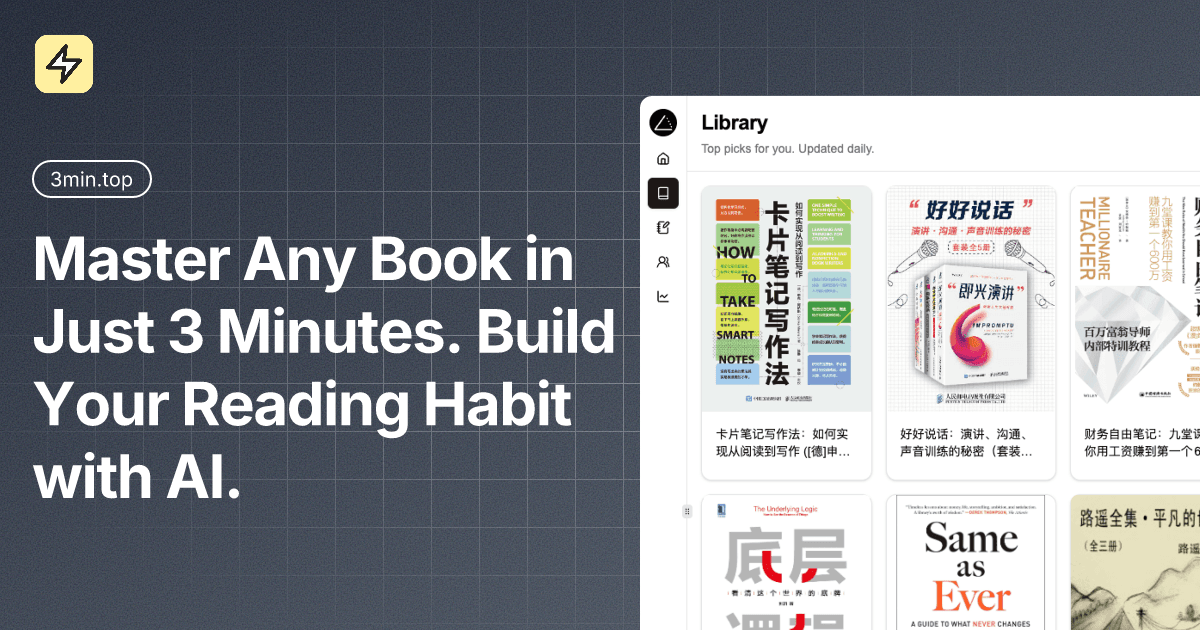
3MinTop is specifically designed for fragmented reading, with each book's core content distilled into 3-minute readable summaries. This means even with just 3 minutes, you complete a full reading unit and gain immediate sense of achievement by finishing a book's essence. The psychological burden is zero, making it easy to maintain consistency. Many users report that starting with the 3-minute micro-habit naturally extends to 10-15 minutes within weeks because the psychological resistance has been eliminated. The key is starting small enough that failure becomes nearly impossible.
Step 2: Design Powerful Triggers and Environmental Cues
The Science of Triggers: Making Habits Automatic
Neuroscientist Wendy Wood's research demonstrates that context cues are the key to habit automation. When specific environmental elements appear consistently, your brain builds neural associations that eventually trigger behaviors without requiring willpower. Her studies show that up to 43% of daily behaviors occur in the same location and time each day, suggesting that environmental design is more powerful than motivation alone.
Four Types of High-Efficiency Triggers
Time-based triggers work by anchoring to fixed moments like 7:15 AM every morning or physiological signals such as feeling tired. Location-based triggers utilize specific places like your reading chair in the study or your commute route on the subway. Behavior chain triggers add reading after existing habits, such as reading for 3 minutes immediately after brushing teeth, using what Clear calls "habit stacking." Emotion-based triggers connect reading to emotional states, like reading to relax when stressed or opening a book when bored while waiting. Research from the European Journal of Social Psychology shows that people who use implementation intentions ("When situation X arises, I will perform response Y") are 2-3 times more likely to follow through compared to those with only goal intentions. Choose 1-2 of your most reliable triggers and avoid overwhelming yourself with too many options, which can lead to execution confusion.
Environmental Design: Make Reading Inevitable
Your physical environment should make reading the path of least resistance. Create dedicated reading spaces by designating a specific chair, corner, or spot that becomes psychologically associated with reading. Use visual cues strategically by placing books in high-visibility locations like your nightstand, coffee table, or bag—seeing them triggers the behavior. Remove competing temptations by putting your phone in another room or using app blockers during reading time. Optimize lighting and comfort to ensure your reading space is inviting, with good lighting, comfortable seating, and minimal distractions. A fascinating study from Cornell University's Food and Brand Lab found that simply changing the visibility and accessibility of food choices altered consumption patterns by up to 25% without any conscious effort. The same principle applies to reading—when books are visible and accessible, you read more.
Step 3: Build Reward Systems That Reinforce the Habit
Understanding Dopamine and Reward Mechanisms
Dopamine, often called the "motivation molecule," plays a crucial role in habit formation. Stanford neuroscientist Dr. Andrew Huberman explains that dopamine is released not just when you receive a reward, but in anticipation of it. This anticipatory dopamine is what drives you to repeat behaviors. The key is creating immediate, tangible rewards that your brain associates with reading.
Three Types of Effective Rewards
Immediate gratification rewards provide instant satisfaction, such as checking off a day on your reading calendar, enjoying a favorite beverage while reading, or using a satisfying bookmark or reading tracker app. Progress visualization rewards make your advancement tangible through streak counters showing consecutive reading days, visual progress bars for books completed, or monthly reading statistics and graphs. Social accountability rewards leverage community support by sharing your progress with a friend or online community, joining reading challenges with others, or posting about books you've finished on social media. Research published in the Journal of Personality and Social Psychology found that people who publicly commit to goals and share progress updates are 33% more likely to achieve them compared to those who keep goals private.
The Danger of Over-Rewarding
While rewards are powerful, be cautious about extrinsic rewards that are too large or unrelated to reading itself. Stanford psychologist Carol Dweck's research on motivation warns that over-reliance on external rewards can undermine intrinsic motivation. If you reward yourself with expensive purchases or elaborate treats every time you read, you may start reading only for the reward rather than for the inherent value of learning. The most sustainable rewards are those that enhance the reading experience itself, such as a cozy reading nook, a beautiful bookmark, or the satisfaction of discussing ideas with others. These rewards strengthen your identity as "someone who reads" rather than "someone who reads to get rewards."
Step 4: Track Progress and Celebrate Milestones
The Power of Measurement
Management consultant Peter Drucker famously said, "What gets measured gets improved." This principle applies powerfully to habit formation. Research from the American Psychological Association shows that people who track their progress toward goals are significantly more likely to achieve them compared to those who don't.
What to Track: Key Metrics
For reading habits, focus on these essential metrics. Track consecutive days with your current streak and longest streak achieved. Monitor books completed by counting total books finished and pages read. Record reading time with daily minutes spent reading and weekly totals. Note reading velocity by tracking how your speed improves over time. The key is tracking consistently without becoming obsessive. The goal is awareness and motivation, not perfection.
Tools and Methods for Tracking
You can use various tracking methods depending on your preference. Physical trackers include wall calendars with X marks for each day, bullet journal reading logs, or habit tracker printables. Digital solutions offer apps like Habitica, Streaks, or Goodreads, spreadsheets with reading statistics, or built-in tracking features in reading apps. 3MinTop provides automatic tracking that records your reading days, completed books, and reading duration with visualized statistics and progress graphs, making it easy to see your improvement over time. A study published in Healthcare found that digital tracking tools increased habit adherence by 27% compared to no tracking, primarily because they provide immediate feedback and visual progress indicators.
Celebrating Milestones: The Psychology of Progress
Don't wait until day 30 to celebrate. Research on motivation shows that frequent small celebrations are more effective than one large celebration at the end. Celebrate these milestones: completing your first 7-day streak, finishing your first book summary, reaching 30 consecutive days, and achieving your monthly reading goal. Celebrations don't need to be elaborate. They can be as simple as sharing your achievement with a friend, treating yourself to a favorite snack, or taking a moment to reflect on how far you've come. The act of acknowledgment itself releases dopamine and reinforces the behavior.
Step 5: Maintain Flexibility and Handle Setbacks
The Myth of Perfection
One of the biggest mistakes people make when building habits is believing they need perfect execution. Research from the University of Pennsylvania shows that perfectionism is actually counterproductive to goal achievement because it leads to all-or-nothing thinking. Missing one day becomes a reason to quit entirely. The reality is that life happens. You'll get sick, travel, face emergencies, or simply have days when everything goes wrong. The difference between people who successfully build habits and those who don't isn't perfect execution—it's resilient recovery.
The 80% Rule: Good Enough Is Excellent
Aim for 80% consistency rather than 100% perfection. If you read 24 out of 30 days in your first month, that's a massive success. Research on habit formation shows that occasional lapses don't significantly impact long-term habit development as long as you resume quickly. What matters is the overall pattern, not individual days. A study in the European Journal of Social Psychology found that missing a single day of a new habit had no detectable impact on long-term success, but missing multiple consecutive days significantly reduced the likelihood of habit establishment. The key is getting back on track within 24-48 hours.
Strategies for Handling Interruptions
When you miss a day, implement these recovery strategies. First, analyze without judgment by asking what caused the interruption and what you can learn from it. Adjust your system by modifying your trigger time if the original doesn't work or changing your reading location if the environment isn't conducive. Resume immediately by reading even just 1 minute the next day to rebuild momentum and avoiding the trap of "I'll start again on Monday." Plan for known disruptions by preparing for travel with downloaded content and adjusting expectations during busy periods rather than abandoning the habit entirely.
Growth Mindset: Setbacks as Learning Opportunities
Psychologist Carol Dweck's research on growth mindset shows that viewing setbacks as learning opportunities rather than evidence of failure significantly increases long-term success rates. People with a growth mindset ask "What can I learn from this?" instead of "Why can't I do this?" When you face reading challenges, practice this reframing: instead of "I failed because I missed three days," think "I learned that evening reading doesn't work for me; I'll try morning reading instead." This shift in perspective transforms obstacles into valuable data that improves your system.
Customized Strategies for Different Lifestyles
Not everyone's life looks the same, so your reading habit strategy shouldn't be one-size-fits-all. Here are tailored approaches for different situations.
For Busy Professionals
If you're juggling meetings, deadlines, and long work hours, try these strategies. Use commute time by listening to audiobooks or reading summaries on 3MinTop during your train or bus ride. Leverage lunch breaks by reading for 5-10 minutes after eating instead of scrolling social media. Create morning rituals by reading for 3 minutes before checking email to start your day with learning. Keep reading material accessible by having a book or app ready on your phone for unexpected waiting time.
For Parents with Young Children
Parenting demands are unpredictable, so flexibility is key. Read during nap time by making it your designated reading window. Model reading behavior by reading alongside your children during their reading time. Use early mornings by waking up 15 minutes before your kids for quiet reading time. Choose shorter formats by using book summaries that fit into brief windows of availability.
For Students
Academic schedules offer both challenges and opportunities. Pair with study breaks by reading for pleasure between study sessions to refresh your mind. Use reading as a reward by finishing a chapter after completing assignments. Join reading groups to add social accountability and make reading more engaging. Diversify content by alternating between academic and pleasure reading to maintain interest.
For People with ADHD
Attention challenges require specific accommodations. Leverage hyperfocus periods by reading during your high-energy windows when concentration is easier. Use timers and alarms to create structure and prevent reading sessions from becoming overwhelming. Choose highly engaging content by starting with topics you're genuinely passionate about. Break into micro-sessions by reading for just 1-2 minutes multiple times per day if longer sessions feel impossible. Combine with movement by walking while listening to audiobooks or using a standing desk for reading.
The 30-Day Reading Challenge: Your Action Plan
Ready to start? Here's your complete implementation checklist.
Preparation Phase (Day 0)
Complete these setup tasks before beginning. Choose your start date, ideally today or tomorrow to maintain momentum. Determine your daily reading moment by selecting a fixed time and identifying your trigger. Prepare your reading environment by removing distractions and placing reading materials visibly. Set up your tracking system using a calendar, app, or 3MinTop's built-in tracker. Select your first 5 books by choosing topics that genuinely interest you. Recruit an accountability partner by telling a friend or family member about your challenge.
Daily Execution (Days 1-30)
Each day, follow this simple routine. Read for 3 minutes at your designated time and trigger moment. Mark completion on your tracking system immediately after finishing. Write 1-2 sentences about a key takeaway to reinforce learning and retention.
Weekly Review (Every 7 Days)
At the end of each week, conduct a brief review. Calculate your execution rate for the week. Adjust your strategy if execution rate is below 80%, identifying what's not working and making necessary changes. Celebrate your consecutive days by acknowledging your progress. Report to your accountability partner by sharing your wins and challenges.
Handling Setbacks
If you miss a day, follow this protocol. Analyze the cause without self-judgment, asking what prevented you from reading. Make system adjustments by changing your trigger time, location, or format if needed. Resume within 24 hours by reading even just 1 minute to rebuild momentum.
Completion Phase (Day 31)
After 30 days, take time to reflect and plan ahead. Calculate your final execution rate to see your overall consistency. List all books you've completed to visualize your achievement. Write down your top 3 learnings from the challenge. Celebrate your accomplishment with a meaningful reward or by sharing your success. Set your next 30-day goal, perhaps increasing to 5 minutes or 50 books.
Real Success Stories: How Others Built Their Reading Habits
Sarah: The Busy Executive
Sarah, a 38-year-old marketing director, hadn't finished a book in three years despite buying dozens. Her schedule was packed with meetings, client calls, and family responsibilities. She started the 30-day challenge using 3MinTop during her morning coffee routine, reading just 3 minutes before checking email. By day 10, she noticed the habit becoming automatic. By day 20, she was naturally extending to 7-10 minutes. After 30 days, she had completed 28 days of reading (93% execution rate) and absorbed insights from 35 book summaries. Her biggest takeaway: "I thought I didn't have time to read. I actually didn't have a system. Once I had a system, time appeared."
Michael: The College Student
Michael, a 21-year-old engineering student, struggled with reading despite knowing it would help his career. Academic textbooks felt like enough reading, and pleasure reading seemed impossible to fit in. He joined the challenge with a focus on business and self-improvement books, reading during his lunch break between classes. His execution rate was 80% (24 out of 30 days), with interruptions during midterm exams. Instead of giving up, he adjusted by switching to audiobooks during his walk to campus. By the end, he had completed 31 book summaries and discovered a genuine love for reading. His advice: "Don't let perfect be the enemy of good. Missing a few days doesn't mean failure."
Jennifer and Tom: The Accountability Partners
Jennifer and Tom, coworkers at a tech startup, decided to do the challenge together. They chose the same books on 3MinTop and spent 5 minutes each Friday discussing what they learned. This social element transformed the challenge from a solo task into a shared experience. Both achieved 100% execution rate (30 out of 30 days), crediting their accountability partnership as the key factor. They continued the habit beyond 30 days, expanding their reading time to 10 minutes daily. Their recommendation: "Find someone to do this with you. The social commitment makes it so much easier."
Frequently Asked Questions
Q: What if I miss more than one day in a row? Missing consecutive days is more challenging than missing a single day, but it's not a failure. Research shows that habits can withstand occasional interruptions if you resume quickly. If you miss 2-3 days, don't restart your count—simply continue from where you left off. The goal is building a long-term pattern, not achieving a perfect streak. Analyze what caused the interruption, adjust your system if needed, and get back on track within 48 hours. Q: Is 3 minutes really enough to make a difference? Yes, absolutely. The goal of 3 minutes isn't to read entire books in that time—it's to establish the habit loop in your brain. Research on habit formation shows that consistency matters more than duration in the early stages. Once the habit is automatic (usually after 60-90 days), you'll naturally extend the time because the psychological resistance is gone. Many 3MinTop users report that starting with 3 minutes led to 15-30 minute reading sessions within two months. Q: Should I read physical books, e-books, or audiobooks? The best format is the one you'll actually use consistently. Research shows that comprehension rates are similar across formats when the content is the same. Physical books work well for dedicated reading time at home. E-books and apps like 3MinTop are perfect for commuting and waiting time. Audiobooks are ideal for multitasking during exercise, commuting, or household chores. Many successful readers use a combination of all three depending on the situation. Q: What if I don't remember what I read? Retention is a common concern, but it's often overestimated as a problem. Research shows that even if you don't consciously remember everything, reading still shapes your thinking and vocabulary. To improve retention, try these strategies: write one sentence summarizing the key idea immediately after reading, discuss what you learned with someone else, use spaced repetition by reviewing key points after 1 day, 1 week, and 1 month, and apply one idea from your reading to your life within 24 hours. Q: How do I choose what to read? Start with topics you're genuinely curious about rather than what you think you "should" read. Interest is the strongest predictor of reading consistency. If you're unsure, try the "5-page rule"—read 5 pages and if you're not engaged, choose something else. 3MinTop offers personalized recommendations based on your interests and reading history, making it easier to discover books you'll actually enjoy.
Conclusion: Your Reading Journey Starts Today
Building a reading habit isn't about willpower or finding more time—it's about designing a system that makes reading inevitable. The five steps outlined in this article—starting with micro-habits, designing powerful triggers, building reward systems, tracking progress, and maintaining flexibility—are backed by decades of neuroscience and behavioral psychology research. Remember these core principles as you begin your journey. Start small with 3 minutes being infinitely better than zero minutes. Prioritize environment over willpower by optimizing your context rather than relying on motivation alone. Embrace progress over perfection, with 80% execution rate being a massive success. View setbacks as learning opportunities by adjusting your system and continuing forward. Use tools that support your habit, as platforms like 3MinTop can significantly increase your success rate. The data is compelling: users who follow this 30-day challenge with 3MinTop achieve an average execution rate of 85%, compared to 63% for those attempting to build reading habits on their own. The difference isn't talent or discipline—it's having the right system and tools. Don't wait for the "perfect time" to start. The perfect time is now. Choose one book that interests you, set a 3-minute timer, and begin your first day. Thirty days from now, you'll thank yourself for taking action today. Ready to transform your reading habits? Visit 3MinTop and start your 3-minute reading journey. Join millions of users who have already built lasting reading habits through this science-backed approach. Your future self is waiting for the knowledge you're about to gain.
Related Articles:
- Best AI Book Summarizer Apps in 2026: 3MinTop vs Blinkist vs Headway Complete Guide
- How Busy Professionals Read 100 Books Per Year with Just 3 Minutes Daily
- The Science of Learning: Why Book Summaries Improve Retention